Showing posts with label Stone. Show all posts

Standing Male God (possibly Shiva) - 6th Century Gupta Period Sculpture


Source: metmuseum.org

Mahakala - 11th-12th Century Pala Period Black Stone Sculpture


Note: Mahakala is a wrathful manifestation of Shiva Bhairava, taken up in an Esoteric Buddhist context as a fierce manifestation of the bodhisattva Avalokiteshvara as guardian of the dharma (Buddhist law) and the sangha (community of monks and nuns). He is shown here enthroned on a lotus cushion—another supports his pendant foot—wielding a sword and trident and displaying a skull cup (kapala); his missing fourth hand likely held the flaying knife. He wears a skull diadem with radiating flames. A skull garland is slung around his waist, and snakes form his sacred cord and armbands. A kneeling couple, presumably the donors who commissioned the icon, make an offering below. A Sanskrit inscription in proto-Bengali script identifies them: it states, in part, “this is the pious gift of Dahapati.”

Source: metmuseum.org

Vishnu with His Consorts, Lakshmi and Sarasvati - 11th-12th Century Pala Period Black Stone Sculpture


Source: metmuseum.org

Manjuvajra Mandala (Esoteric form of Manjushri, the Bodhisattva of Transcendent Wisdom) - 11th Century Pala Period Black Stone Buddhist Sculpture


Source: metmuseum.org

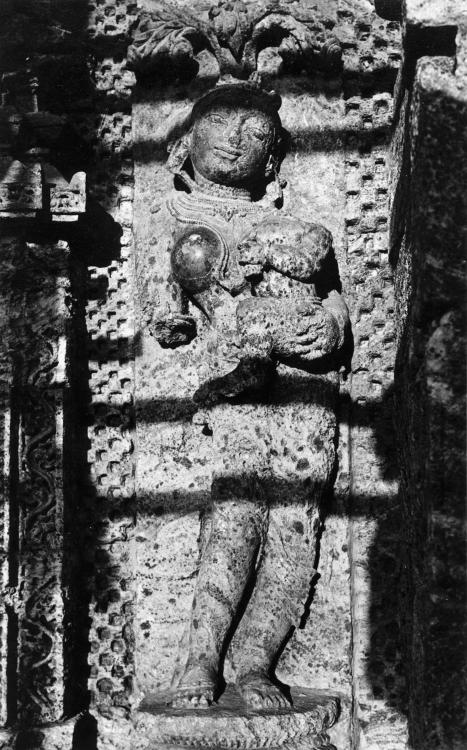
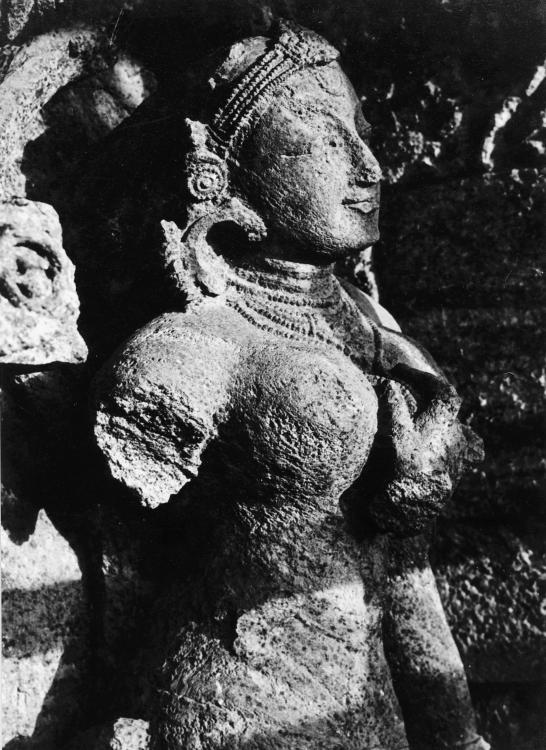
Female Figures of Konark Sun Temple - 13th Century, Orissa, India


Source: The Digital South Asia Library ( http://dsal.uchicago.edu )

Surasundari Sculptures of Konark Sun Temple - 13th Century Orissa India


Source: The Digital South Asia Library ( http://dsal.uchicago.edu )

Konark Sun Temple Wall Details - Orissa, India


Source: The Digital South Asia Library ( http://dsal.uchicago.edu )

Seated Ganesha - Hoysala Dynasty - 12th-13th Century

Source: http://www.asia.si.edu

This sculpture displays the ornate carving and exuberant decoration characteristic of art created under the Hoysala dynasty (1042–1346). The decorated floral arch surrounding the sculpture suggests that it once occupied a cell or niche in a temple.

Photographs from the Official Catalogue of the Indian Art Exibition, Delhi 1903 - Part 2

 Bharatpur Facade in White Sandstone

 Brass and Copper Ware

 Collection of Lapidary work including stone-inlaying

 Encrusted Ware

 Jodhpur Jarokha in red and white sandstone

 Metal Lamps

 Selected Inlaid Stone Work

  Selection of Minor Stone Work

Tinned, Painted and Lacquered Metal Wares

Wire Damascening or Koftgari

Writer: George Watt
Source: Archive.org