Showing posts with label 17th Century. Show all posts
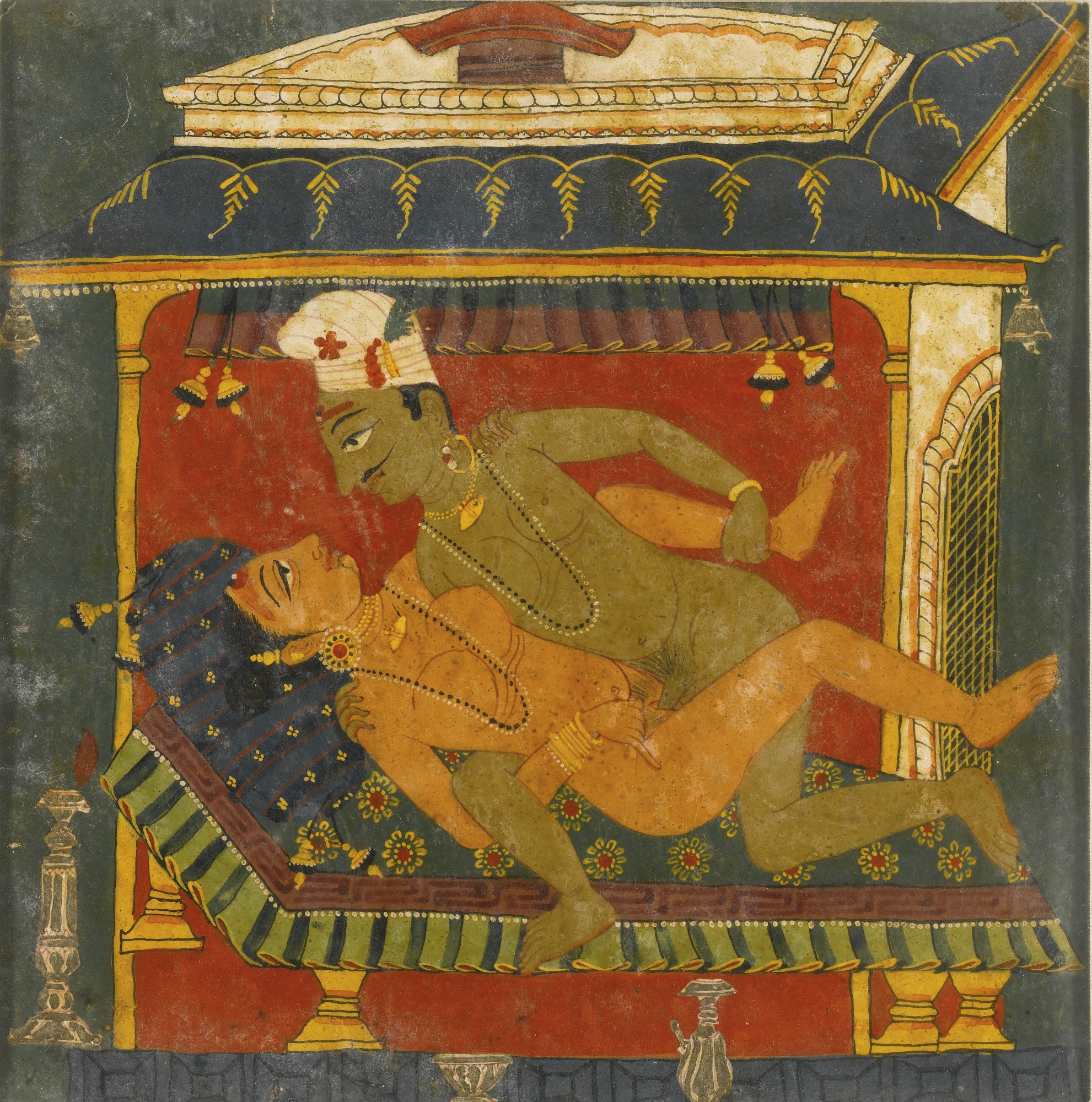
The Unexpected Return of the Husband - Rajput Painting, Sirohi, 17th Century
The husband in red leading his battle horse into the courtyard greeted by a servant girl with a golden tray of fruit, the lady of the house reclining on the balcony in an embrace together with her lover and a servant, inside a turreted haveli with scrolling floral balustrades, a yellow header with devanagari inscription, surrounded by red margins.
Medium: Opaque pigments on wasli heightened with gold
Credit: christies.com
The Ordeal by Liquor - Nurpur or Chamba, circa 1680-1700
This scene of a famous episode (see below) is painted in a distinctive style that can be associated with Chamba or Nurpur in the last quarter of the seventeenth century. There are several stylistically comparable works from these schools, mostly from Chamba (see Archer 1973, vol.2, p.50, nos.1-3; Goswamy and Fischer 1992, pp.130-1, figs.36-40; Archer 1976, p.21, no.11; Chandra 1971, pp.133-4, no.22 (Chamba); Archer 1973, vol.2, p.302, no.2 (Nurpur)). The Chamba examples cited here have in turn been associated by Goswamy and Fischer with the career of the artist termed by them "The Master at the Court of Raja Chattar Singh of Chamba", who was active from circa 1675 to about 1710 (see Goswamy and Fischer 1992, pp.127-147).
It is interesting to note that two of the Chamba examples cited, the Nurpur example and the present painting all concern liquor. In the two Chamba examples they depict a scene of abstinence in which the Raja Chattar Singh is forsaking alcohol - he empties a decanter of wine in a very deliberate gesture suggested by Goswamy and Fischer to be associated with a vow the raja has taken. In the present work and the Nurpur example the scene concerns an excess of alcohol. The episode is known as the "ordeal by liquor" and refers to an episode during Jahangir's tour of the country around Nurpur in 1621 which appears in the Tuzuk-i-Jahangiri ('Memoirs of Jahangir'): "At this time [1621] it was reported to me that there was a Sannyasi Moti in the neighbourhood who had entirely renounced control over himself. I ordered them to bring him that I might ascertain the real state of affairs.... When he came into my presence I examined him, and found a wonderful state of persistence. It occurred to me that in a state of drunkenness and absence of mind and delirium, some change might be wrought in him. Accordingly I ordered them to give him some cups of spirits (‘araq) of double strength. This was done in royal fashion, but not the least change took place, and he remained in the same passive state. At last his senses left him, and they carried him out like a corpse. God Almighty granted him mercy so that he did not lose his life. Certainly there was great persistence in his nature." (Rogers-Beveridge 1989, 2nd of 2 vols. in 1, p.226-7). Jahangir was so impressed that he endowed the Pindori with a temple. In the popular version of this story, the liquor was poison and there was the added element of the same liquid being given to an elephant, which promptly died, further underlining the staying powers of the holy man. That this episode occurred in the Nurpur area may make a Nurpur provenance slightly more likely for the present work, although the style is closer to Chamba.
Two further published Pahari miniatures from the late-seventeenth and early-eighteenth century depict this episode, indicating that this theme was a popular one (see Bhatia 1982, p.30, pl.XVII, fig.1 (Nurpur, third quarter seventeenth century); Kala 1961, pl.16 (as Basohli, early eighteenth century).
Credit: sothebys.com
Illustration of a Nilgai (Boselaphus tragocamelus) - Mughal Painting, Circa 1640
This painting of a nilgai (also called a blue bull or Boselaphus tragocamelus), which is an antelope indigenous to Asia, is attributable to the reign of the Mughal emperor Shah Jahan (r. 1037-1068 AH / 1627-1658 CE). Such animal studies were popular commissions among the Mughal emperors, who showed a marked curiosity about the natural world in their royal histories. Patronage of paintings of flora, fauna, and animals received a particular impetus under the Mughal emperor Jahangir (r. 1014-1037 AH / 1605-27 CE) and was continued under later Mughals. The detailed foliage in the foreground and the light green background are comparable to other studies of single animals dating to c. 1049 AH / 1640 CE.
Credit: thedigitalwalters.org
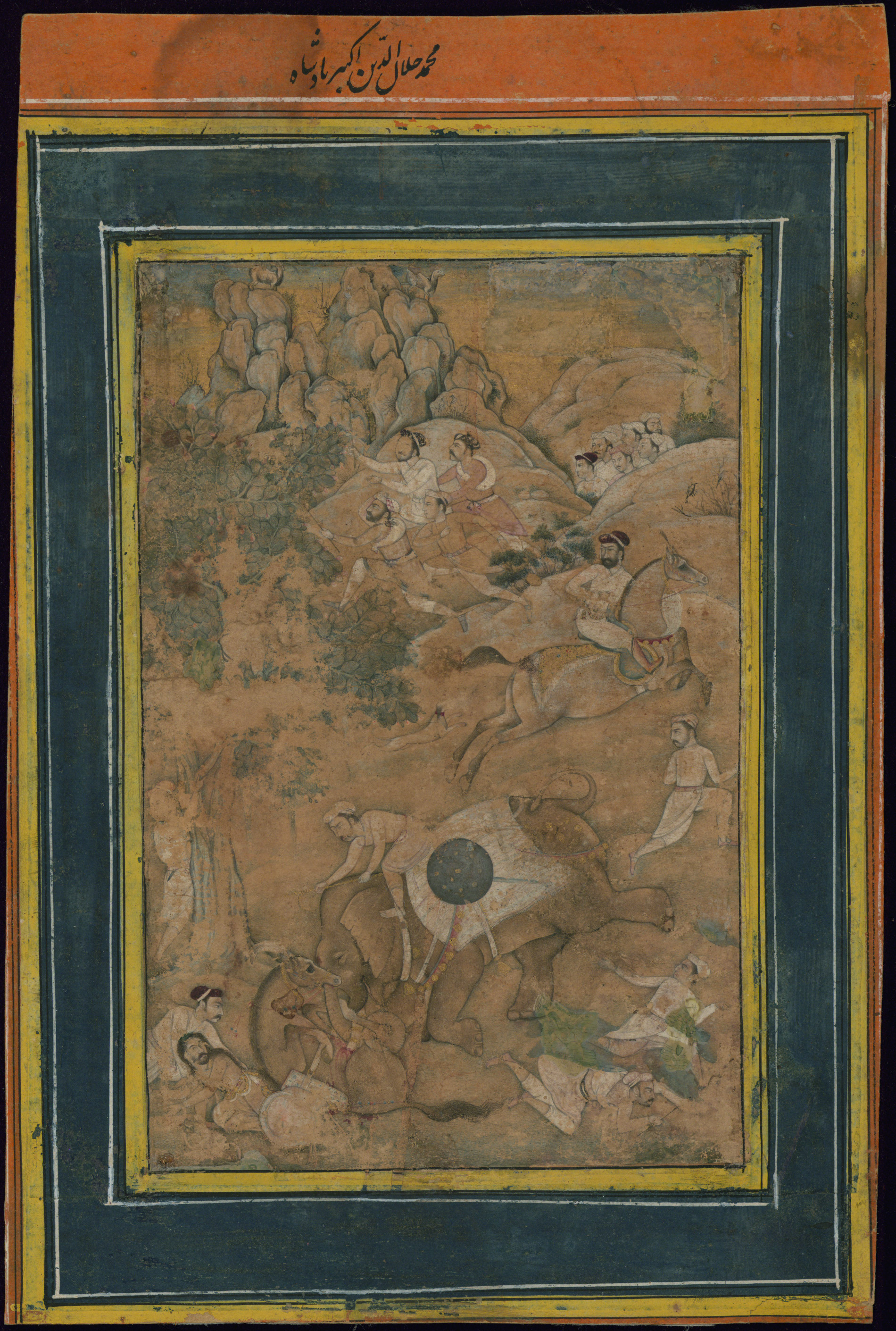
Emperor Akbar is Riding and Controlling his Elephant, which has Gone into Heat (Must) - Mughal Painting, Circa 17th Century
This single leaf depicts the Mughal emperor Akbar (r. 963-1014 AH / 1556–1605 CE), who continues to ride and control his elephant, which has gone into heat (must). The elephant is shown attacking a horse, whose rider has fallen beneath his steed. In turn, the horse bites the elephant’s trunk. The event documents the courage and determination of the emperor, who is identified in an inscription at the top of the page in black nastaʿlīq script as Muḥammad Jalāl al-Dīn Akbar Pādshāh. This inscription was likely written by a later viewer. The border, in yellow, black, blue, and orange, probably dates to the thirteenth century AH / nineteenth CE.
Credit: thedigitalwalters.org
A Composite Illustration from the Razmnama - Mughal Painting 1616-17

This leaf comes from the one of the major illustrated reproductions of the Razmnama, a Persian translation of the Hindu epic the Mahabharata. During this period two other versions were produced; a dispersed copy originating from 1598 and a version dating from 1605. This particular copy of 1616-17 was commissioned by the great bibliophile 'Abd al-Rahim, also commander of the Mughal armies to which he was appointed in 1584.
Credit: sothebys.com
Marriage procession in a bazaar - Pahari Painting, Mandi c. 1640-50
A princely bridegroom on a horse is escorted to his wedding by riders, attendants and musicians. Painted by a Mughal-trained master working at the Hill court of Mandi, this procession scene gives an unusually vivid view of a prosperous 17th century bazaar. The shops sell brass vessels, pan (betel-leaf), sweets, glass or ceramic flasks and vases, knives, daggers and sword-hilts, textiles, and grains and pulses.
Credit: http://jameelcentre.ashmolean.org/
Subscribe to:
Posts (Atom)