Showing posts with label 18th Century. Show all posts

Dancing girls - Mixture of Mughal and Rajput styles, Circa 18th Century


Credit: thedigitalwalters.org

Portrait of Third Mughal Emperor Akbar - Mughal Painting, Circa 18th Century

Portrait of Third Mughal Emperor Akbar - Mughal Painting, Circa 18th Century

This painting depicts the third Mughal Emperor Akbar (r. 963 AH / 1556 CE -- 1014 AH / 1605 CE). It was executed in Mughal India in the twelfth century AH / eighteenth CE. Akbar is shown seated on a throne and holding the crown in his hands. The inscription in Devanagari script on the left side identifies the sitter as Akbar. The image is framed by salmon and blue borders with illuminated floral motifs.

Credit: thedigitalwalters.org

Mughal Emperor with a Docuemnt - Mughal Painting, circa 18th or 19th Century

Mughal Emperor with a Docuemnt - Mughal Painting, circa 18th or 19th Century

This painting depicts a Mughal emperor, yet to be identified, seated in an inlaid chair of European design, on the bank of a brook in a rocky landscape. He is reading an unrolled document which may have been presented to him by the figure standing to his left. The standing figure bears some physiognomic resemblance to portraits of the Mughal emperor Akbar (r. 963-1014 AH / 1556-1605 CE). On the ground between the two figures is a crown and garment. A figure on horseback makes the gesture of surprise in the background. The painting was executed in India during the twelfth or thirteenth century AH / eighteenth or nineteenth CE. The polychrome floral borders surrounding the image are not much later than the image itself.

Credit: thedigitalwalters.org

Portrait of Lal Kunwar, the beloved of the eighth Mughal Emperor Jahandār Shāh - Mughal Painting Circa 18th century

Portrait of Lal Kunwar, the beloved of the eighth Mughal Emperor Jahandār Shāh -  Mughal Painting Circa 18th century

Portrait of Lal Kunwar, the beloved of the eighth Mughal Emperor Jahandār Shāh -  Mughal Painting Circa 18th century

This Mughal color-wash drawing, dating to the twelfth century AH / eighteenth CE, depicts Lāl Kunwar, the beloved of the eighth Mughal Emperor Jahandār Shāh (d. 1125 AH / 1713 CE). Originally a dancing girl, she became Jahandār's concubine and later the queen consort. Contemporary historians noted Jahandār Shāh's decadent lifestyle and his devotion to the female entertainer Lāl Kunwar, who is named in the inscription at the top of the page. Reportedly, Lāl Kunwar had much influence at Jahandār's court. The seals in the upper corners of the page were added later.

Credit: thedigitalwalters.org

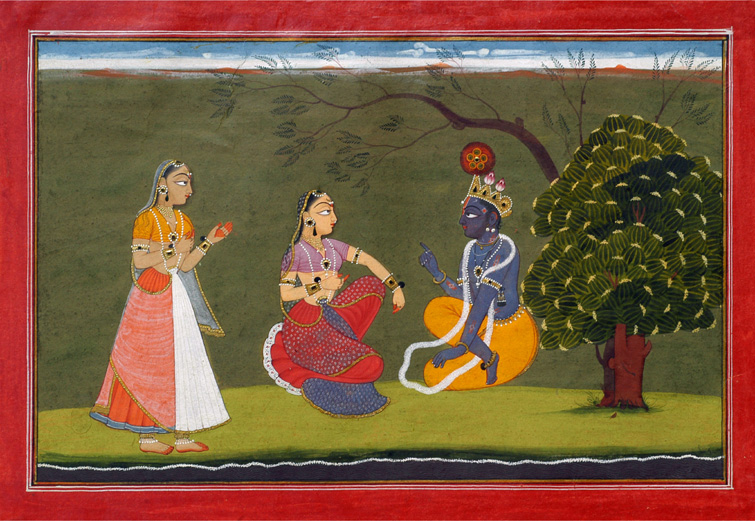
Radha and Krishna in Discussion (An Illustration from Gita Govinda) - Basohli Painting Circa 1730

Radha and Krishna in Discussion (An illustration from Gita Govinda) -  Basohli Painting Circa 1730

Medium: Gouache on paper
Source: http://chdmuseum.nic.in

Lady Engaged in Lovemaking with Her Lover - Rajput Painting, Probably Marwar, Late 18th Century

Lady Engaged in Lovemaking with Her Lover - Rajput Painting, Probably Marwar, Late 18th Century

Credit: christies.com

A Man Laying on a Divan with a Lady Standing and Holding Him in a Lovemaking Embrace - Miniature Painting, North India, Probably Basholi, Early 18th Century

A Man Laying on a Divan with a Lady Standing and Holding Him in a Lovemaking Embrace - Miniature Painting, North India, Probably Basholi, Early 18th Century

Credit: christies.com

A Couple Standing with Limbs Intertwined in a Lovemaking Embrace - Miniature Painting, North India, Mankot, Early 18th Century

A Couple Standing with Limbs Intertwined in a Lovemaking Embrace - Miniature Painting, North India, Mankot, Early 18th Century

A male and female lovers standing with limbs intertwined in a sexual embrace, both with Vishnaivite vertical ceremonial markings on their foreheads, with garments hanging at right and large tree to the left, a large floral cushion and textile on the floor, with maroon background set inside white ruled red margins.

Credit: christies.com

Couple Engaged in Lovemaking in Sitting Position - Miniature Painting, Mewar, Circa 1760


Source: christies.com

Sporting Couple Engaged in Lovemaking, Holding Various Weapons - Rajput Painting, Probably Bundi, Late 18th Century

Sporting Couple Engaged in Lovemaking Holding Various Weapons - Rajput Painting, Probably Bundi, Late 18th Century

Credit: christies.com

Couple Engaged in Lovemaking by Candlelight - Miniature Painting, North India, Probably Nurpur, Late 18th Century

Couple Engaged in Lovemaking by Candlelight - Miniature Painting, North India, Probably Nurpur, Late 18th Century

Credit: christies.com

Man Pleasuring Himself in front of His Lover - Miniature Painting, Probably Chamba, Circa 1765


Credit: christies.com

An Assembly of Hindu gods, Ascetics and Worshippers - Deccan Painting, Hyderabad or Bidar, early 18th century

An Assembly of Hindu gods, Ascetics and Worshippers - Deccan Painting, Hyderabad or Bidar, early 18th century


In this vibrant and unusually large and complex painting, the worshipping supplicant Kakoji Ram, in gold, sits in the centre foreground surrounded by gods, ascetics and other worshippers. Behind them a landscape spreads into the distance either side of a highway-like river of commuting fish, while a herd of elephants marches across the green hills, and in the thundery sky gods float in a golden throne. The quality and intricate detail of this painting is ravishing, rewarding close and lengthy examination.

It can be compared to several works attributed to Hyderabad or Bidar in the very late-seventeenth and early-eighteenth centuries; the distinctive Deccani outcroppings of rock in the landscape can be seen in a number of works from the region (for example, lot 46 in this catalogue) and other stylistic traits appear in works including a manuscript illustration of birds in a jungle (see Zebrowski 1983, p.218, no.188); a series of complex Ragamala paintings from early-eighteenth-century Bidar (ibid, pp.226-228, nos.199-201 and pp. 231-2, nos.202-3); a garden portrait of Allah-wirdi Khan from early-eighteenth-century Hyderabad (ibid, p.236, no.209, col.pl.XXII); and, closest of all in style, detail and overall composition, a large and complex scene of a prince receiving water from girls at a well in a landscape setting, also from early-eighteenth-century Hyderabad (ibid, p.241, no.216). For a slightly later example of the tiered crowns of the gods see Zebrowski 1983, p.276, no.256.

The identification in the Christie's 1988 sale catalogue of the subject as Bhairav Raga was based on an eighteenth-century Deccani Ragamala illustration showing Siva and Parvati in the Kankroli Art Collection, Baroda (Ebeling 1973, p.27, no.C1), but this seems unlikely for the present work, as does the Christie's attribution to Murshidabad.

Credit: sothebys.com

Couple on a Bed in the Lovemaking Asana of Phanabhritpasha - Nepal, Bhaktapur, circa 1700


Medium: Opaque watercolour with gold on treated cloth

This posture, 'The Knot of the Hooded One', is descibed in the 'Ratiratnapradipika' ( composed by Maharaja Prauadha Devaraya of Vijayanagara r.1422-66): "When your lover passes her arms under her raised thighs and twines her fingers together behind your neck, pulling your face down to be kissed"

Source: indianminiaturepaintings.co.uk