Showing posts with label Miniature Painting. Show all posts
The Unexpected Return of the Husband - Rajput Painting, Sirohi, 17th Century
The husband in red leading his battle horse into the courtyard greeted by a servant girl with a golden tray of fruit, the lady of the house reclining on the balcony in an embrace together with her lover and a servant, inside a turreted haveli with scrolling floral balustrades, a yellow header with devanagari inscription, surrounded by red margins.
Medium: Opaque pigments on wasli heightened with gold
Credit: christies.com
An Assembly of Hindu gods, Ascetics and Worshippers - Deccan Painting, Hyderabad or Bidar, early 18th century
In this vibrant and unusually large and complex painting, the worshipping supplicant Kakoji Ram, in gold, sits in the centre foreground surrounded by gods, ascetics and other worshippers. Behind them a landscape spreads into the distance either side of a highway-like river of commuting fish, while a herd of elephants marches across the green hills, and in the thundery sky gods float in a golden throne. The quality and intricate detail of this painting is ravishing, rewarding close and lengthy examination.
It can be compared to several works attributed to Hyderabad or Bidar in the very late-seventeenth and early-eighteenth centuries; the distinctive Deccani outcroppings of rock in the landscape can be seen in a number of works from the region (for example, lot 46 in this catalogue) and other stylistic traits appear in works including a manuscript illustration of birds in a jungle (see Zebrowski 1983, p.218, no.188); a series of complex Ragamala paintings from early-eighteenth-century Bidar (ibid, pp.226-228, nos.199-201 and pp. 231-2, nos.202-3); a garden portrait of Allah-wirdi Khan from early-eighteenth-century Hyderabad (ibid, p.236, no.209, col.pl.XXII); and, closest of all in style, detail and overall composition, a large and complex scene of a prince receiving water from girls at a well in a landscape setting, also from early-eighteenth-century Hyderabad (ibid, p.241, no.216). For a slightly later example of the tiered crowns of the gods see Zebrowski 1983, p.276, no.256.
The identification in the Christie's 1988 sale catalogue of the subject as Bhairav Raga was based on an eighteenth-century Deccani Ragamala illustration showing Siva and Parvati in the Kankroli Art Collection, Baroda (Ebeling 1973, p.27, no.C1), but this seems unlikely for the present work, as does the Christie's attribution to Murshidabad.
Credit: sothebys.com
The Ordeal by Liquor - Nurpur or Chamba, circa 1680-1700
This scene of a famous episode (see below) is painted in a distinctive style that can be associated with Chamba or Nurpur in the last quarter of the seventeenth century. There are several stylistically comparable works from these schools, mostly from Chamba (see Archer 1973, vol.2, p.50, nos.1-3; Goswamy and Fischer 1992, pp.130-1, figs.36-40; Archer 1976, p.21, no.11; Chandra 1971, pp.133-4, no.22 (Chamba); Archer 1973, vol.2, p.302, no.2 (Nurpur)). The Chamba examples cited here have in turn been associated by Goswamy and Fischer with the career of the artist termed by them "The Master at the Court of Raja Chattar Singh of Chamba", who was active from circa 1675 to about 1710 (see Goswamy and Fischer 1992, pp.127-147).
It is interesting to note that two of the Chamba examples cited, the Nurpur example and the present painting all concern liquor. In the two Chamba examples they depict a scene of abstinence in which the Raja Chattar Singh is forsaking alcohol - he empties a decanter of wine in a very deliberate gesture suggested by Goswamy and Fischer to be associated with a vow the raja has taken. In the present work and the Nurpur example the scene concerns an excess of alcohol. The episode is known as the "ordeal by liquor" and refers to an episode during Jahangir's tour of the country around Nurpur in 1621 which appears in the Tuzuk-i-Jahangiri ('Memoirs of Jahangir'): "At this time [1621] it was reported to me that there was a Sannyasi Moti in the neighbourhood who had entirely renounced control over himself. I ordered them to bring him that I might ascertain the real state of affairs.... When he came into my presence I examined him, and found a wonderful state of persistence. It occurred to me that in a state of drunkenness and absence of mind and delirium, some change might be wrought in him. Accordingly I ordered them to give him some cups of spirits (‘araq) of double strength. This was done in royal fashion, but not the least change took place, and he remained in the same passive state. At last his senses left him, and they carried him out like a corpse. God Almighty granted him mercy so that he did not lose his life. Certainly there was great persistence in his nature." (Rogers-Beveridge 1989, 2nd of 2 vols. in 1, p.226-7). Jahangir was so impressed that he endowed the Pindori with a temple. In the popular version of this story, the liquor was poison and there was the added element of the same liquid being given to an elephant, which promptly died, further underlining the staying powers of the holy man. That this episode occurred in the Nurpur area may make a Nurpur provenance slightly more likely for the present work, although the style is closer to Chamba.
Two further published Pahari miniatures from the late-seventeenth and early-eighteenth century depict this episode, indicating that this theme was a popular one (see Bhatia 1982, p.30, pl.XVII, fig.1 (Nurpur, third quarter seventeenth century); Kala 1961, pl.16 (as Basohli, early eighteenth century).
Credit: sothebys.com
Bhima Kills Kichaka and his brothers, signed by Dhannu from Razmnama - Mughal Miniature Painting, circa 1598-99
This Razmnama painting in nim-qalam style depicts Bhima killing Kichaka and his hundred and one brothers as a punishment for Kichaka's lecherous behaviour towards Draupadi. The inscription in nasta'liq below the painting reads 'Bhima killing Kichaka together with one hundred and one brothers and Draupadi pulling [herself] from the hand of [their] associates'. The text on the reverse is from the Mahabharata Book IV, 21-24, and tells the story illustrated here.
The Razmnama is the abridged version of the Hindu epic poem the Mahabharata which tells the story of a rivalry between cousins, the Pandavas and the Kauravas, for the kingdom of Hastinpura. One of the central figures is the god Krishna, who assists the Pandava brothers. This vast work was translated into Persian at the request of Akbar in 1582-83 but the presentation manuscript with 168 paintings, now preserved in the Maharaja Sawai Man Singh II Museum in Jaipur, was not completed until 1586 (for illustrations of some of them see Das in Das et al. 1998, pp.52-66).
The current illustration comes from the second copy of the Razmnama that was finished in 1598-99, the final five parts and colophon of which are housed in the British Library. However, it is not merely a replica of the imperial prototype, as less than a fifth of its paintings, including the present scene, are represented in the Jaipur Razmnama.
This full page work, along with nine of the manuscript's other paintings, is by the artist Dhannu, a prolific painter of the imperial Mughal atelier of the period 1580-1605. His earliest works can be found in the Darabnama of circa 1580, and later in the Tarikh-i Khandan-i Timuriyya, the Jaipur Razmnama, the Victoria and Albert Museum Akbarnama, the Keir Collection Khamsa of Nizami, the Jaipur Ramayana, the British Library Baburnama, the National Museum of Delhi Baburnama, the 'Iyar-i Danish, the 1596 Chingiznama and the Akhlaq-i Nasiri. The most distinctive feature of Dhannu's painting style is his treatment of the faces which at times borders on caricature. In this instance many of the faces are finely drawn, particularly that of the wild-haired Bhima, whose expression, whilst effortlessly dispatching four brothers, verges on the nonchalant. The body of the dead Kichaka burns on a pyre in the foreground. For a detailed discussion of the 1598 Razmnama see Seyller 1985. This painting is additional to the nine other paintings by Dhannu listed there.
Credit: sothebys.com
Page from a Manuscript of Akbarnāmah (Biography of the Mughal Emperor Akbar) - Mughal Painting, 16th Century
This leaf depicting the scene of a fatal quarrel over a prostitute comes from a manuscript of Akbarnāmah (a biography of the Mughal Emperor Akbar [r. 963 AH / 1556 CE -- 1014 AH / 1605 CE]) by his prime minster Abū al- Faz̤l ibn Mubārak (d. 1011 AH / 1602 CE). It was produced in Mughal India at the end of the tenth century AH / sixteenth CE.
Credit: thedigitalwalters.org
A Yellow-Backed Woodpecker, attributed to Mansur - Mughal Miniature Painting, circa 1585-90

When this painting of a woodpecker was first published, in The British Museum exhibition catalogue of 1976 Paintings from the Muslim Courts of India, the entry, written by Dr. Ellen Smart linked it to illustrations of birds and animals in the early copies of the Baburnama. Subsequently this link has been cemented with an attribution to the great Mughal master Mansur, who is particularly known for his paintings of birds and animals, and who painted several of the early Baburnama illustrations of natural history.
Mansur began his career in the late 1580s, when his early style of natural history painting appears in the Baburnama, c.1589. He rose to become the most skilled and illustrious of the Indian painters of fauna and flora in the seventeenth century. He was fortunate that his royal patrons were very interested in natural history, following in the footsteps of Babur and Humayun, and his natural prowess in this direction allowed a flowering of his career and a chance to fulfil his great talent. Emperor Jahangir (ruled 1605-27) mentioned him four times in his Tuzuk-i Jahangiri and awarded him the title of Nadir al-’Asr ('Wonder of the Age'). He was also an exceptional illuminator, contributing illuminated pages and borders to several royal manuscripts and albums.
The type of bird represented here has for a long time been slightly mis-identified. It is in fact a Black-Rumped Flameback Woodpecker (Dinopium benghalense), sometimes known as a Lesser Golden-Backed Woodpecker. It is a widespread resident of the Indian subcontinent, inhabiting open forests and often breeding in old tamarisk and acacia trees.
Credit: sothebys.com
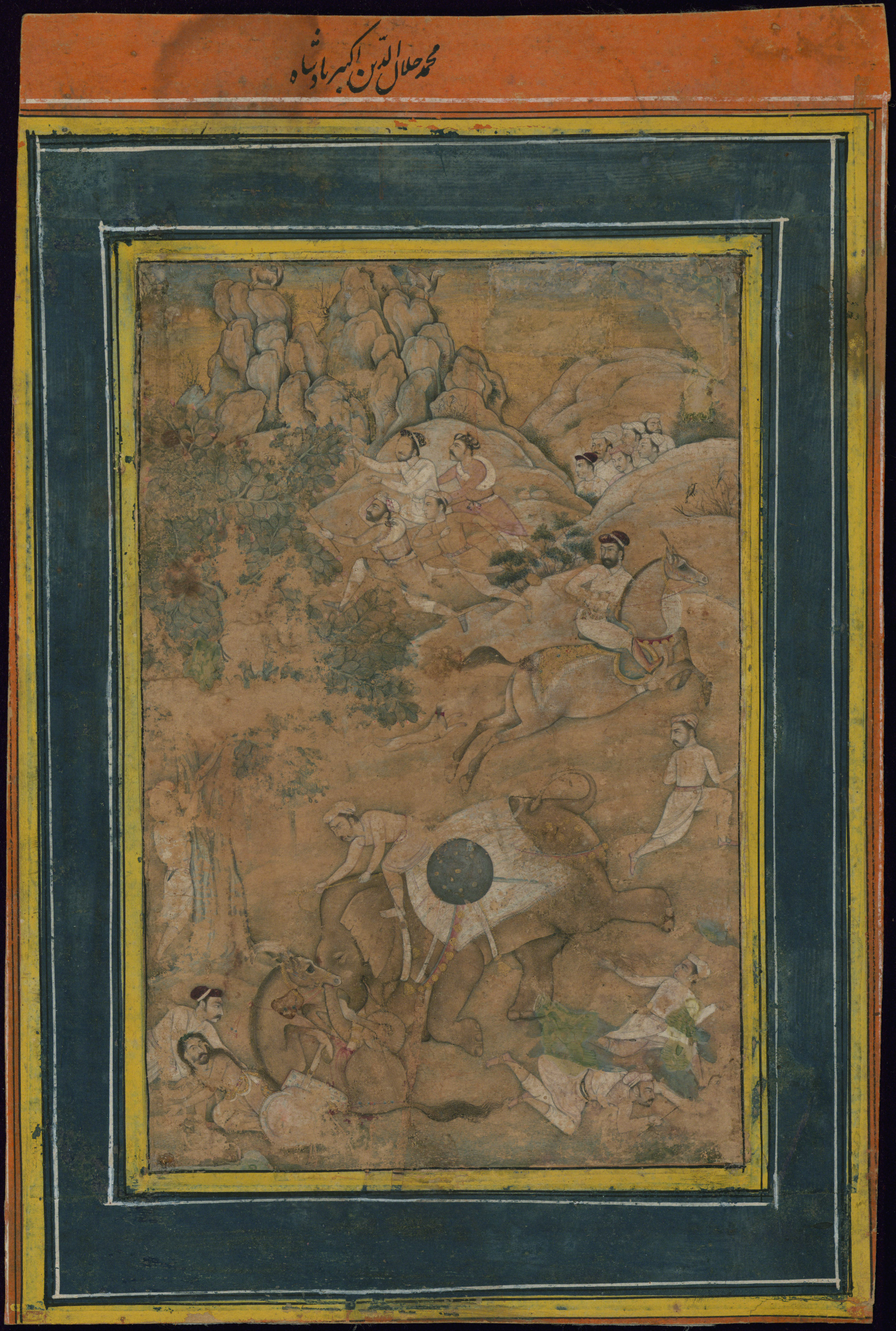
Emperor Akbar is Riding and Controlling his Elephant, which has Gone into Heat (Must) - Mughal Painting, Circa 17th Century
This single leaf depicts the Mughal emperor Akbar (r. 963-1014 AH / 1556–1605 CE), who continues to ride and control his elephant, which has gone into heat (must). The elephant is shown attacking a horse, whose rider has fallen beneath his steed. In turn, the horse bites the elephant’s trunk. The event documents the courage and determination of the emperor, who is identified in an inscription at the top of the page in black nastaʿlīq script as Muḥammad Jalāl al-Dīn Akbar Pādshāh. This inscription was likely written by a later viewer. The border, in yellow, black, blue, and orange, probably dates to the thirteenth century AH / nineteenth CE.
Credit: thedigitalwalters.org
Three women Seated within Two Leafy Bowers and Awaiting for their Lovers - Miniature Painting, Circa 18th Century
This painting, dating to the twelfth century AH / eighteenth CE, depicts three women seated within two leafy bowers. The Nayaka (female lover or heroine) sits alone, while her two female companions, known as sakhis, converse in the other bower. The painting may represent Utka nayaka, a classification for heroines who are awaiting or yearning for their lovers. Often, they are shown on a bed of flowers or leaves that they have prepared in expectation of meeting their lovers. In the landscape are animals engaged in various activities. An outcrop of rocks in the distance forms a horizon, above which is a blue sky streaked with light gray or white washes to suggest a thin layer of high clouds.
Credit: thedigitalwalters.org
Mughal Prince Dara Shikoh and the Holy Man Shah Sarmad (Sarmad Kashani) Seated unde a Tree - Mughal Painting, Circa 18th Century
According to inscriptions written in nastaʿlīq script, this painting depicts the Mughal prince Dārā Shikōh (b. 1024 AH / 1615 CE) and the holy man Shāh Sarmad (Sarmad Kashani) seated under a tree. Behind the wise man stands an attendant with a peacock-feather fan. A celebrated scholar, sufi, and ruler, Dārā Shikōh was the eldest son of Shāh Jahān.
Credit: thedigitalwalters.org
Subscribe to:
Posts (Atom)